How to Choose the Right ERP System for a Mid-Sized Manufacturing Company

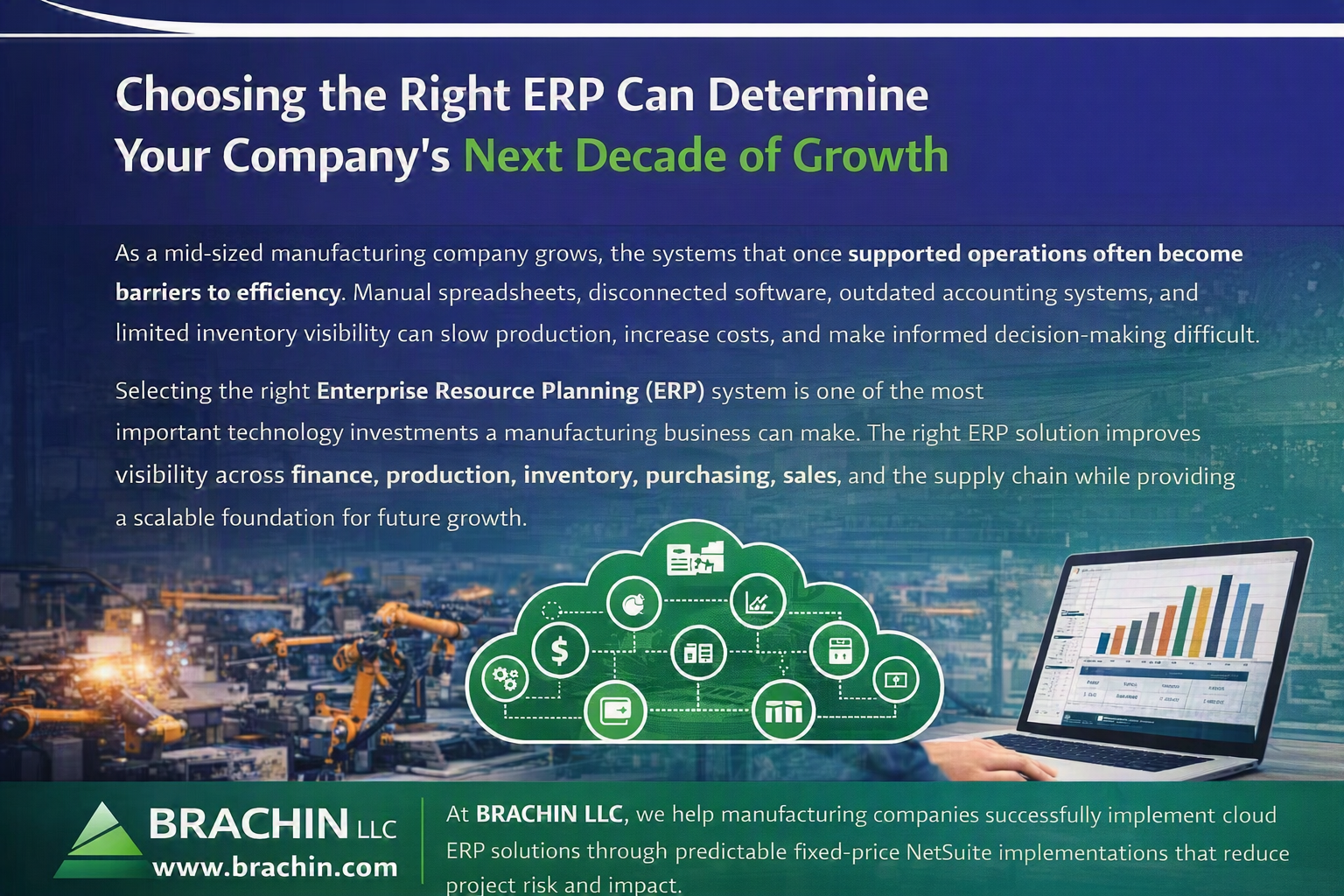
Choosing the Right ERP Can Determine Your Company's Next Decade of Growth
Signs Your Manufacturing Company Has Outgrown Its Current ERP System
How to Choose the Right ERP System for a Mid-Sized Manufacturing Company
As a mid-sized manufacturing company grows, the systems that once supported operations often become barriers to efficiency. Manual spreadsheets, disconnected software, outdated accounting systems, and limited inventory visibility can slow production, increase costs, and make informed decision-making difficult.
Selecting the right Enterprise Resource Planning (ERP) system is one of the most important technology investments a manufacturing business can make. The right ERP solution improves visibility across finance, production, inventory, purchasing, sales, and the supply chain while providing a scalable foundation for future growth.
At BRACHIN LLC, we help manufacturing companies successfully implement cloud ERP solutions through predictable fixed-price NetSuite implementations that reduce project risk and improve implementation success.
This guide explains how manufacturing executives can evaluate ERP systems, compare leading solutions, avoid costly implementation mistakes, and confidently select the best ERP platform for their business.
Who Should Read This Guide?
This guide is designed for:
Chief Executive Officers (CEOs)
Chief Financial Officers (CFOs)
Operations Managers
Manufacturing Directors
Plant Managers
Supply Chain Leaders
IT Directors
ERP Project Teams
Whether you're replacing QuickBooks, Microsoft Dynamics GP, Sage, or another legacy ERP, this guide will help you understand what to look for before making a major investment.
Signs Your Manufacturing Company Has Outgrown Its Current ERP System
Many manufacturers delay ERP replacement because their existing software "still works." Unfortunately, the hidden costs of outdated systems often exceed the investment required for modernization.
Common warning signs include:
Limited Inventory Visibility
If inventory levels differ between departments or require manual reconciliation, your ERP may no longer support operational growth.
Too Many Spreadsheets
When employees rely on Excel to compensate for system limitations, data becomes inconsistent and reporting becomes unreliable.
Manual Production Scheduling
Production planning should be automated using demand forecasts, capacity planning, and real-time inventory.
Slow Financial Reporting
Month-end close should not require weeks of manual consolidation.
Multiple Disconnected Systems
Separate applications for accounting, CRM, purchasing, warehouse management, and manufacturing create duplicate data and unnecessary work.
Lack of Real-Time Reporting
Executives should have immediate access to KPIs instead of waiting for manually generated reports.
Increasing Customer Demand
Growing businesses require scalable ERP software capable of supporting additional facilities, warehouses, products, and users.
What Should a Manufacturing ERP System Include?
Not every ERP solution is designed for manufacturing.
Look for software that includes:
Financial Management
General Ledger
Accounts Payable
Accounts Receivable
Cash Management
Multi-company consolidation
Budgeting
Financial reporting
Inventory Management
Real-time inventory tracking
Multiple warehouse support
Lot tracking
Serial number management
Cycle counting
Barcode integration
Production Planning
Manufacturers should be able to:
Schedule production
Track work orders
Manage bills of materials (BOMs)
Plan capacity
Forecast demand
Monitor production costs
Supply Chain Management
A modern ERP should help organizations:
Manage vendors
Track purchase orders
Improve procurement
Reduce lead times
Optimize inventory
Warehouse Management
Look for:
Mobile scanners
Pick/pack/ship workflows
Warehouse optimization
Bin management
Shipping integration
Business Intelligence
Executives need dashboards showing:
Production efficiency
Inventory turnover
Gross margin
Manufacturing costs
Cash flow
Customer profitability
Cloud ERP vs. On-Premise ERP
One of the first decisions manufacturers face is whether to invest in cloud ERP or maintain on-premise software.
Cloud ERP Advantages
Lower infrastructure costs
Automatic software updates
Remote access
Strong security
Faster deployment
Easier scalability
Reduced IT maintenance
Cloud ERP is often the preferred option for growing manufacturers seeking flexibility and long-term value.
On-Premise ERP Advantages
Some organizations still prefer on-premise ERP because they want complete control over servers or have unique regulatory requirements.
However, on-premise systems typically involve:
Higher hardware costs
Longer implementation timelines
Internal IT maintenance
More expensive upgrades
For many mid-sized manufacturers, cloud ERP provides a better balance of scalability, accessibility, and total cost of ownership.
Comparing Leading ERP Systems for Manufacturing
Selecting an ERP platform requires evaluating functionality, scalability, implementation complexity, and long-term business goals.
Oracle NetSuite
Best for:
Growing manufacturers
Multi-location operations
Multi-company organizations
Cloud-first businesses
Strengths include:
Unified cloud platform
Strong financial management
Inventory management
Manufacturing functionality
Demand planning
Real-time dashboards
Global scalability
Microsoft Dynamics 365
Best for organizations already invested in the Microsoft ecosystem.
Strengths include:
Microsoft integration
Flexible deployment
Power BI reporting
Office 365 connectivity
SAP Business One
Designed for small and mid-sized businesses needing manufacturing and financial management.
Strengths include:
Production management
Inventory control
Global availability
Acumatica
Known for flexible licensing and cloud deployment.
Strengths include:
Manufacturing Edition
Distribution features
Open architecture
The best ERP depends on your industry, operational complexity, growth plans, reporting needs, and implementation strategy.
Questions Every Manufacturing Executive Should Ask ERP Vendors
How Much Does an ERP Implementation Cost?
Before selecting an ERP platform, ask:
Can the software support multiple manufacturing plants?
Does it include production scheduling?
Can it manage bills of materials?
Does it provide demand forecasting?
How does inventory planning work?
What reporting capabilities are included?
Is mobile access available?
What implementation methodology is used?
How long is the implementation?
What is the expected ROI?
How Much Does an ERP Implementation Cost?
ERP implementation costs vary depending on:
Company size
Number of users
Manufacturing complexity
Customizations
Data migration
Third-party integrations
Training requirements
Beyond software licensing, organizations should budget for implementation services, data migration, user training, testing, and post-go-live support.
One way to reduce financial uncertainty is to work with an implementation partner that offers fixed-price engagements, providing greater cost predictability than traditional time-and-materials projects.
Typical ERP Implementation Timeline
While every project is different, many mid-sized manufacturing implementations follow this general timeline:
Discovery and requirements gathering
Solution design
System configuration
Data migration
Integration development
User acceptance testing
Employee training
Go-live
Post-go-live optimization
The duration depends on project scope, business complexity, and organizational readiness.
Common ERP Selection Mistakes
Avoid these common pitfalls:
Choosing Based Only on Price
The least expensive ERP often becomes the most expensive if it cannot scale with your business.
Ignoring Future Growth
Select software that supports future acquisitions, additional facilities, and international expansion.
Over-Customizing
Excessive customization increases implementation costs and complicates future upgrades.
Underestimating Change Management
Successful ERP projects require executive sponsorship, employee engagement, and effective training.
Selecting the Wrong Implementation Partner
Technology alone does not determine project success. The experience, methodology, and industry knowledge of your implementation partner are equally important.
Why Implementation Expertise Matters
Even the best ERP software can fail if implementation is poorly managed.
Successful ERP implementations require:
Proven project management
Manufacturing expertise
Financial process knowledge
Data migration experience
Risk management
Executive communication
User training
Post-go-live support
Working with experienced consultants helps reduce project delays, unexpected costs, and operational disruption.
Why Manufacturers Choose BRACHIN LLC
Partner with BRACHIN LLC to achieve better outcomes through proven consulting expertise and results-focused transformation.
At BRACHIN LLC, we specialize in helping manufacturing and distribution companies implement Oracle NetSuite using a structured, transparent, and predictable approach.
Our consulting services include:
Fixed-price NetSuite implementations
ERP strategy and planning
Business process analysis
Solution design
Data migration
System configuration
User training
Post-go-live optimization
Manufacturing best practices
Distribution process improvements
Our fixed-price implementation model helps organizations reduce budget uncertainty while maintaining clear project scope, defined milestones, and measurable outcomes.
Frequently Asked Questions
What is the best ERP system for a mid-sized manufacturing company?
The best ERP depends on your business requirements, production processes, reporting needs, and growth plans. Many mid-sized manufacturers choose cloud-based ERP solutions because they provide scalability, real-time visibility, and lower infrastructure costs.
Should manufacturers move to cloud ERP?
For many organizations, cloud ERP reduces IT maintenance, improves accessibility, simplifies upgrades, and supports business growth. Companies with unique regulatory or infrastructure requirements may still choose on-premise solutions.
How long does ERP implementation take?
Implementation timelines vary based on company size, data quality, business complexity, integrations, and project scope. Proper planning and experienced implementation partners help keep projects on schedule.
Why are fixed-price ERP implementations valuable?
Fixed-price engagements provide predictable project costs, clearer scope, and stronger budget control compared to open-ended time-and-materials contracts.
Ready to Modernize Your Manufacturing ERP?
Choosing an ERP system is more than selecting software—it's selecting the technology foundation that will support your operations for years to come.
If your manufacturing company is evaluating Oracle NetSuite or planning an ERP modernization initiative, BRACHIN LLC can help you assess your requirements, reduce implementation risk, and deliver a successful fixed-price implementation.
Contact BRACHIN LLC to discuss your ERP strategy and learn how our fixed-price NetSuite implementation services can help your business improve operational efficiency, gain real-time visibility, and support long-term growth.
“Selecting the right ERP system is one of the most important technology decisions a mid-sized manufacturing company can make. The right platform does more than improve daily operations — it creates the foundation for greater visibility, smarter decision-making, and sustainable growth for years to come.
BRACHIN LLC is the trusted partner to help companies navigate this critical decision. With the right expertise, strategy, and ERP approach, BRACHIN LLC helps manufacturing organizations build a stronger operational foundation and position their businesses for continued success into the next decade.”
– BRACHIN LLC Customer
Get In Touch
If you're interested in working with us, complete the form with a few details about your project. We'll review your message and get back to you within 48 hours.